The world continues to experience unprecedented warming, with 2025 on track to be among the hottest years on record despite the waning influence of the strong El Niño event that drove 2024’s record temperatures.
Current Temperature Trends
2025 is virtually certain to rank as the second or third warmest year on record, with global temperatures approximately 1.4°C above pre-industrial levels. While unlikely to exceed 2024’s record, the year has maintained exceptionally high temperatures, with January setting a new monthly record and subsequent months consistently ranking in the top three warmest for their respective periods.
The rate of human-induced warming has accelerated to 0.27°C per decade over 2015-2024, the fastest rate in recorded history. This represents a significant increase from 0.2°C per decade observed in the 1970s, demonstrating that climate change is not only continuing but intensifying.
Atmospheric Carbon Concentrations
Carbon dioxide levels reached a new record high of 422.8 ppm in 2024, with the largest single-year increase ever recorded at 3.75 ppm. By May 2025, monthly CO2 concentrations peaked at 430.5 ppm. This surge was driven by continued fossil fuel emissions combined with reduced natural carbon absorption due to wildfires, droughts, and high temperatures associated with El Niño conditions.
Global carbon emissions from fossil fuels hit 41.6 billion tonnes in 2024, continuing an upward trajectory with no signs of the peak that scientists say is urgently needed. Despite some recent decreases in monthly emissions, the overall trend remains deeply concerning.
Critical Climate Indicators
Carbon Budget Depletion
The remaining carbon budget to limit warming to 1.5°C will be exhausted in approximately three years if emissions continue at 2024 levels. This represents a dramatic shrinking of the window for avoiding the most severe climate impacts.
Sea Level Rise Acceleration
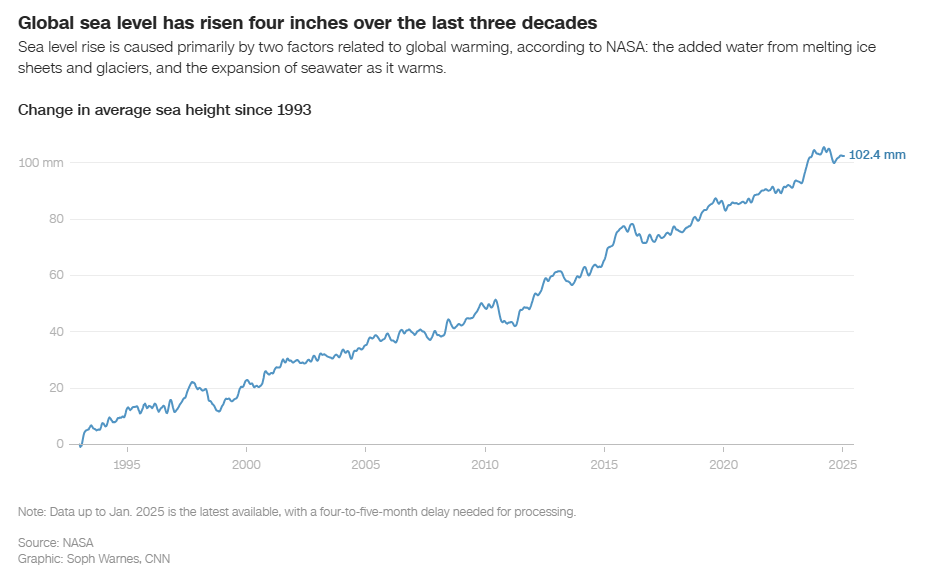
Sea levels are rising at 3.31 mm per year, more than double the rate observed in the early 20th century. The acceleration is driven by both thermal expansion of warming oceans and accelerating ice loss from major ice sheets.
Greenland is losing ice at a rate of 265 billion tonnes annually, while Antarctica loses 134 billion tonnes per year. Research published in 2025 suggests that even limiting warming to 1.5°C may be insufficient to prevent catastrophic ice sheet collapse and multi-meter sea level rise over coming centuries.
Arctic Changes
Arctic sea ice reached its lowest winter maximum extent on record in March 2025, continuing a long-term decline pattern where all ten smallest winter extents have occurred since 2007. The ice is also becoming thinner and more fragile, fundamentally altering Arctic ecosystems and shipping possibilities.
Climate Tipping Points
New research indicates a 62% probability of triggering multiple climate tipping points under current policy trajectories. These include potential collapse of major ice sheets, Amazon rainforest dieback, permafrost thaw, and disruption of ocean circulation patterns. However, rapid emissions reductions could significantly reduce these risks.
Temperature Projections
The World Meteorological Organization projects an 86% chance that at least one year between 2025-2029 will exceed 1.5°C above pre-industrial levels, and a 70% chance that the five-year average will exceed 1.5°C. While this represents temporary breaches rather than the sustained warming threshold referenced in the Paris Agreement, it signals that the world is rapidly approaching this critical benchmark.
Extreme Weather Impacts
2025 has already witnessed severe climate impacts globally. The year began with devastating extreme weather events that have killed over 1,800 people in Europe alone due to heatwaves. Record-breaking temperatures have affected regions from the Arctic Circle to tropical zones, while extreme precipitation events have caused deadly flooding across multiple continents.
The Path Forward
Despite these alarming trends, scientists emphasize that rapid decarbonization could still significantly reduce future risks. Research shows that achieving net-zero emissions could halve warming rates over the next two decades. However, this requires unprecedented global action, as current policies remain insufficient to prevent dangerous climate change.
The latest science makes clear that while the 1.5°C target is becoming increasingly difficult to achieve, every fraction of a degree matters for reducing the severity of climate impacts. The next few years represent a critical window for implementing the transformational changes needed to safeguard the planet’s climate system.
 Ron's Musings